Wednesday, January 23, 2013

Downtown Adelaide

The cyclists may have had a day off, but there was no rest for us and we hit the town in wilting heat to do some serious sightseeing. We began with coffee in the Adelaide Arcade in Rundle Mall.

Rundle Mall is the premiere retail area of South Australia and was Australia's first pedestrian street mall. The Italiante styled Adelaide Arcade was the first retail establishment in Australia with electric lighting and is apparently home to six ghosts. We didn't meet any of them.

Adelaide Arcade
The Spheres by Bert Flugelman is locally known as The Malls' Balls
The Rundle Mall Fountain
Another sculpture in the mall is a series of bronze pigs, by Marguerite Derricourt, officially known as A Day Out. They were commissioned by the Adelaide City Council to much controversy, as is always the case with public artwork, and a competition was held to name the pigs.

Truffles and Horatio

Horatio
 
Oliver

Girl on a slide by John S Dowie
Walking along Rundle and Hindley Streets, I looked up at the awnings and shop frontages, which I always like to admire. According to the Lonely Planet, Rundle Street 'has many of the city's funkiest bars, cafes and bookshops. Here you'll find the best in al fresco dining, retro clothing and haute grunge'.

Meanwhile, Hindley Street is apparently, 'Adelaide's West End, where strip clubs rub shoulders with university buildings and specialist bookshops. There are plenty of inexpensive restaurants and snack bars here, plus a number of glitzy bars and dance clubs.'

We found massage parlours, adult book shops, tattoo parlours, fashion boutiques, and the Adelaide Symphony Orchestra. A pub called The Woolshed claimed to be 'the country pub in the city.' This translated as a booze barn with crap fizzy beer, a mechanical bull, and pictures of women wearing bikinis, stetsons and cowboy boots. We moved on.


The eastern end of Rundle Street was the site of Adelaide's original fruit and vegetable wholesale markets. These closed in the 1980s and, after a long and controversial decision-making process involving some government money, the Garden East (or East End Astoria) apartment development was built. This was the start of a growing number of prestige apartment buildings in the area.

Karen Genoff's sculpture The Apron, pays tribute to the market traders. I also like the rules of commerce posted about the Inspector's Office, among them the fines for selling underweight goods, tying horses to the market without permission, wilfully or carelessly damaging any of the market erections, or leaving offal lying about. So mother was right - you will catch your death if you expose your kidneys!


The Apron by Karen Genoff
Cafe ride

North Terrace features a string of magnificent public buildings including the art gallery, museum, state library and the University of Adelaide.This was founded in 1874 from the profits of copper mining and was the first university in Australia to admit women to degree courses.

Within the University grounds, a bronze statue by A Drury commemorates Sir Thomas Elder (1817-1897) who migrated to Adelaide from Kirkcaldy, Scotland, in 1854.  He was a pastoralist, highly successful businessman, philanthropist, politician, race-horse owner and breeder, and public figure. Amongst many other things, he is notable for introducing camels to Australia, contributing them to both Wharburton's 1873 expedition and Giles's in 1875.

The Art Gallery of South Australia received a bequest of £25,000 from him, and he also gave gifts, endowment funds and bequests to the University of Adelaide totalling around £100,000. A statue on the grass seems a small price to pay.

Statue of Sir Thomas Elder by A Dury

Bonython Hall is the 'great hall' of Adelaide University. It was built between 1933 and 1936 with a grant of over £50,000 from Sir Joseph Bonython. There are a couple of rumours about this hall, which are quite interesting. It is opposite Pulteney Street, the only one of the city's north-south thoroughfares which does not continue north through the parklands.

Folklore has it that the Bonython donation was made on the condition that a hall be built opposite Pulteney Street, thus blocking any future path through the parklands and preventing the division of the campus by a major thoroughfare. Folklore also maintains that the Bonython family were very conservative and did not want the building used as a dance hall. Hence, the hall was designed and built with a sloping floor rather than a flat floor.

Bonython Hall, University of Adelaide
Marble statue of Robert Burns by WJ Maxwell
The National War Memorial of South Australia commemorates those who served in the First World War, and is effectively an archway, featuring two scenes by Rayner Hoff. The marble reliefs and bronze statues depict both the prelude and epiloge to the war; the willingness of youth to answer the call of duty and the sacrifices they made.

The work does not display a material victory but the victory of the spirit. The interior is lined with the names of all the South Australians who died in the war. It's very moving and powerful.

The National War Memorial of South Australia
We popped down to Victoria Square, also known to the indigenous Kaurna people as Tarndanya (Red Kangaroo Dreaming), where they used to gather for special ceremonies and dances.

The square is usually dominated by the Victoria Square Fountain, built to commemorate the visit of Her Majesty Queen Elizabeth II and His Royal Highness Prince Philip, Duke of Edinburgh, in 1968. Sculpted by John S Dowie, its theme is based on the three rivers from which Adelaide draws its water supply - Murray; Onkaparinga; and Torrens.

Three Rivers fountain in Victoria Square

For the next week, however, the Tour Down Under Bike Expo has taken over. There are stalls of everything to do with bikes: clothing; monitoring equipment; tyres; brakes; gears; chains; and of course bikes - lots of lovely carbon fibre and titanium. We drooled at all the beautiful two-wheeled porn, and then had to go home for a lie down.

Tuesday, January 22, 2013

People's Choice Classic

Warning: this post contains pictures of cycling - lots of it. I make no apologies for that at all, but just so you know...

Waiting for the start in a somewhat silly (but free) Skoda sunhat
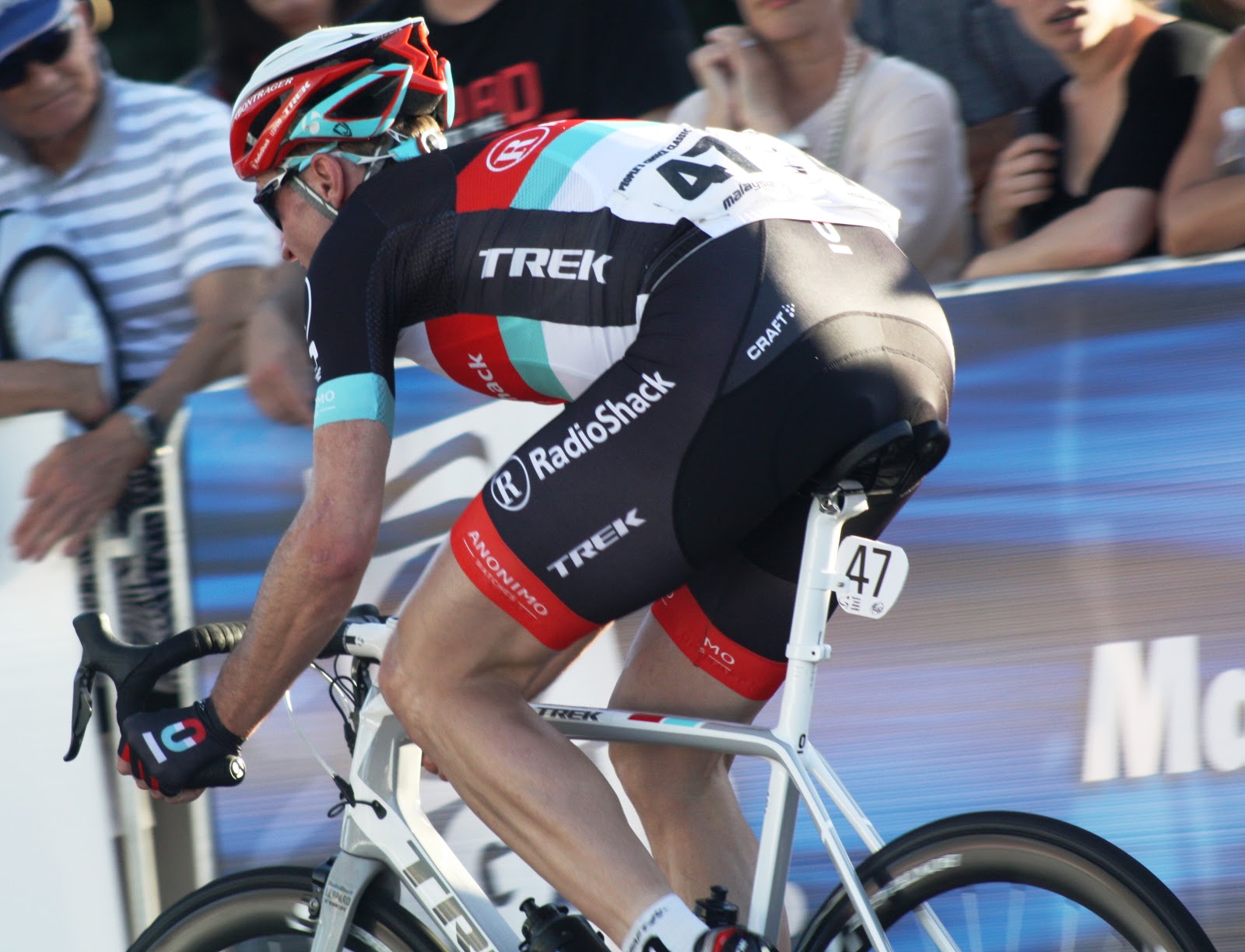
The 51km People's Choice Classic is the forerunner to the Tour Down Under. From the gun (do they start the bike race with a gun?) Jens Voigt (Team Radioshack Leopard Trek) and Damien Howson (UniSA Australia) were off. They raced round at the front for several of the 30 laps of the 1.7km circuit.

Jens Voigt said he didn't contest any of the sprint points to give the young local rider his due. He also made some quip about just wanting to prove that he still had the legs, even if he was racing against someone half his age.

Damien Howson
Jens Voigt
The Team Sky boys seemed to be having fun - laughing and joking and not taking it all that seriously.

Edvald Boasson Hagen
Ian Stannard - my new favourite rider
The Sky Train from behind
It got pretty busy in the peleton.

After it was all over, we walked back through town and saw the cyclists pedalling past and, of course, stopping at the red lights, where it seems they were given helpful advice by passing pedestrians.

Monday, January 21, 2013

Mt Lofty, Hahndorf and Lobethal

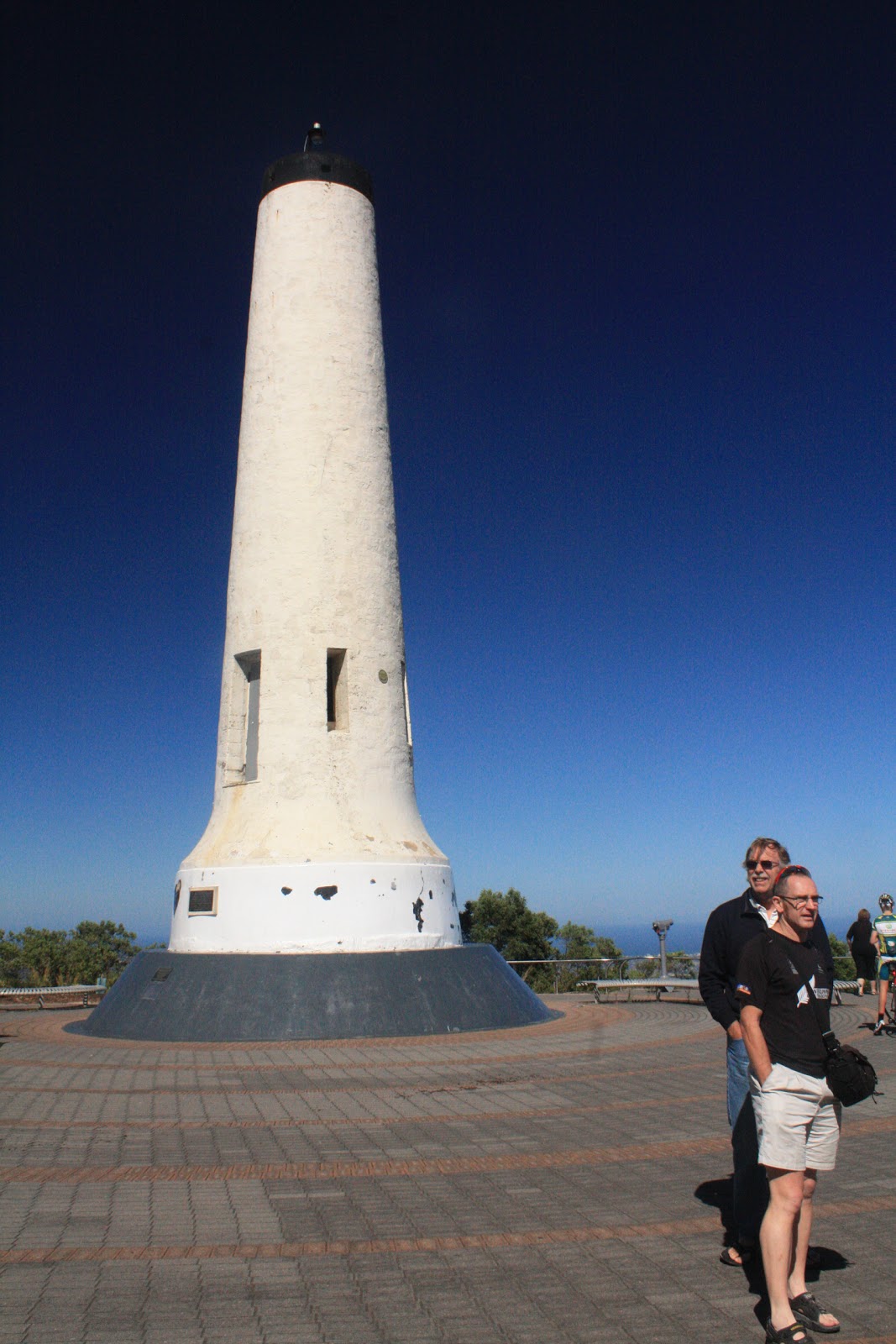
From the top of Mt Lofty you can see Adelaide all laid out before you.

Mt Lofty summit
Adelaide CBD
The town of Hahndorf is absolutely delightful and is described as Australia's oldest surviving German settlement. It has a strong village feel; its streets are planted with 100-year-old plane and elm trees, and lined with cafes, shops, craft outlets and galleries, and the sandstone buildings are softened with roses, vines and lavender.

In 1838, a group of German Lutherans emigrated to South Australia to avoid religious persecution by the King of Prussia. They arrived at Port Adelaide in the ship Zebra under the captaincy of Dirk Hahn (a Dane). He had grown to respect the passengers and promised to help them achieve their goal of settling and farming together, negotiating a parcel of land in the Adelaide Hills for them.

The negotiated contract provided the families with 100 acres of land rent-free for the first year along with a years' provision of seeds and some livestock, all on credit as a communal debt. To earn the money to repay the debt, many of the men left the village to work for wealthy landowners clearing the bush and building fences. The women were left behind to labour on their small farms, raising animals and vegetable gardens and making butter and cheese.


These women found a ready market in Adelaide for their fresh produce (as almost everything was imported to the colony at the time) and they walked the 35km winding track with their goods in baskets on their backs or suspended from yokes across their shoulders. After a few years the 52 pioneer families had completely repaid their debt. They named their settlement Hahndorf (Hahn's village) in honour of Captain Hahn who had helped them achieve their freedom.


During World War One there was anti-German prejudice and this resulted in all the German names of settlements being changed. Hahndorf became Ambleside in 1917. It was reverted to Hahndorf in 1935 as part of South Australia’s centenary celebration.

The villagers are very proud of their German heritage and it is everywhere evident from the taditional menus at the pubs to the structure of the buildings, and the items on sale: clocks; steins and intricate woodwork, candles and German folk art.

I adored the musical boxes (spieldosen), nativity scenes, teddies and santas, little bakers, reindeer and carol singers in lederhosen. The wooden children's toys are outstanding with carvings of old men playing chess, mini fishermen and an entire range of nutcracker soldiers, dentists and beer drinkers!

We called into the German Cake Shop for morning tea, where we had giant pretzel doughnuts and cherry strudel.

Sausages are another German speciality: fresh, cooked, smoked, cured and dried. Several shops display racks of them hung up to tempt buyers with their delectable smell. We bought Aussie-made in the end with a kangaroo salami, and avoided the unsubtly-named bum burner.

Nearby Lobethal was renamed Tweedvale during the anti-German paranoia of WWI but reverted to its original name soon after. It is known for its Christmas festival of lights, its Grand Carnival, weekend markets, and old woolleen mill where the Onkapiringa blankets were made. We appreciated it for its support of the Tour Down Under and its microbrewery.

This artwork made from Paris Creek marble by South Korean sculptor Hwang Seong Woo was commissioned to celebrate Lobethal's woollen mill history - how's that for multicultural!
Naturally we had to visit the microbrewery at Lobethal Bierhaus! Once again we had a tasting paddle so we could sample the wares, beginning with a Bohemian Pilsner (4.8%) - straw colour, yeasty barley taste, crisp and refreshing; recommended as an accompaniment to a fish dish.

We moved onto the Hefeweizen (5.4%) which tasted like those fondant banana sweets and was supposedly good with a summer salad, and then the boldly named Good Bier (4.8%) which was an easy drinking beer with moderate bitterness and citrus flavours - probably a fine match for a cheese and pickle sandwich.

Lobethal Bierhaus, ouside and in.

My favourite was the Bruce (3.5%), which is considered a 'light' beer, although this is actually the usual strength of top English beers (Brakspear's is 3.8%). It's golden brown in colour and made with British malts (including Maris Otter), Whitbread yeast, and a hop combination of UK Challenger and NZ High Alpha variety 'Big Banger'. It's nutty, bitter, hoppy and absolutely yummy.

Their Pale Ale (5.6%) claims to be 'like Little Creatures' although I'm not entirely certain of that. It's an American-hop-based golden copper ale with a sweeter taste and an aroma of pubs. The tasting ntes suggest you pair it with a hot chilli dish or rich food.

The Red Truck Porter ((5.2%) has a roasted malt flavour and a strong suggestion of smoked almonds. And finally the Chocolate Oatmeal Stout (5.8%) relies upon golden rolled oats and English hops and yeast to present hints of chocolate and roasted coffee flavours with a smooth, silky finish. This would invariably be a winter favourite to be savoured in front of a smoky peat fire.

Him Outdoors compares notes with The Friesian
We returned to our hosts to eat our spoils from the markets - date sourdough bread, camembert, fig paste, kangaroo salami, and smoked almonds. Another fine day's touristing.