Hoggy and Him Outdoors setting off on an intrepid biking adventure...
These are called shophouses, because they are shops, with houses above them - obviously.
 |
| Niece Niamh |
 |
| Nephew Aidan |
A trip to the Niah Caves starts off with a boat trip across the river - it's brown because it's muddy, not dirty.
It's quite a long walk there, which the kids are thrilled about, as you can see.
The caves themselves are pretty impressive. People climb up rickety structures (that would never pass Health and Safety measures) to collect the swifts' nests - these are used in Chinese medicine and birds' nest soup. The swifts nesting here (and swooping in and out of the caves twittering and cheeping) are the White-nest Swiftlet and the Black-nest Swiftlet.
The white nests are considered more valuable as they are made with 80% salivia and are thought to bring more health benefits, such as aiding digestion, raising libido, improving the voice, alleviating asthma, omproving focus, and an overall benfit to the immune system. The black nests are only 60% saliva and not as valuable.
Most valuable of all are the red nests - when the swifts come to lay their eggs and find their nests have been removed, they have to create instant nests in which to lay their eggs, and so they cough up blood to do so. That's not pleasant, is it?
You can walk right through the middle of the mountain in this network of caves. Shafts of light pierce through the walls to create mesmerising tableaux. In other places the caves are completely dark; the ceiling lowers until it forms a tight stone chamber where torches cast eerie shadows, distorted drips loom large, and solitary voices create disturbing echoes.
As we were in a narrow corridor beneath countless tonnes of rock, Hoggy suggested we turn off our torches to experience the pitch black and entombed sensation. I'm not a big fan of the dark, enclosed spaces or bats with their gleaming red-eyed reflections and their agitated squeaking. Perhaps I have seen too many horror films, but I felt a panic attack coming on. "Really?" said Hoggy later, "I didn't notice anything wrong." Blesss my clueless big brother!
After we left the Borneo Hagues, we flew to Kota Kinabalu where we sheltered from a torrential downpour and then walked through a steaming market where exposed plug sockets lay in puddles of water. Again we considered that Health and Safety regulations aren't exactly a priority here.
 |
| I've no idea what these fruit are |
 |
| Preparing chicken on the old wooden chopping block |
 |
| Platters of things |
 |
| More dried fish than you can shake a stick at - should you wish to |
 |
| Quite possibly the Levis factory itself? |
They are big on reflexology here. While in Miri Him Outdoors and I went to a massage place where we had an hour of reflexology on our feet. The masseurs didn't speak a word of English and our Malay is not up to much so we communicated in mime.
Through manipulation of my toes, they indicated that I had tension in my neck and pains in my head (which is often true). A series of charades depicting drinking, head waggling, pointing at liver and lower back while making pedalling motions showed that they thought Him Outdoors to be a cycling piss-head. Quite so.
The Atkinson Clock Tower is one of only three colonial buildings left standing after Allied Forces bombed and completely destroyed Kota Kinabalu (then called Jessleton) to liberate North Borneo from Japanese occupation during World War II.
 |
| The Atkinson Clock Tower |
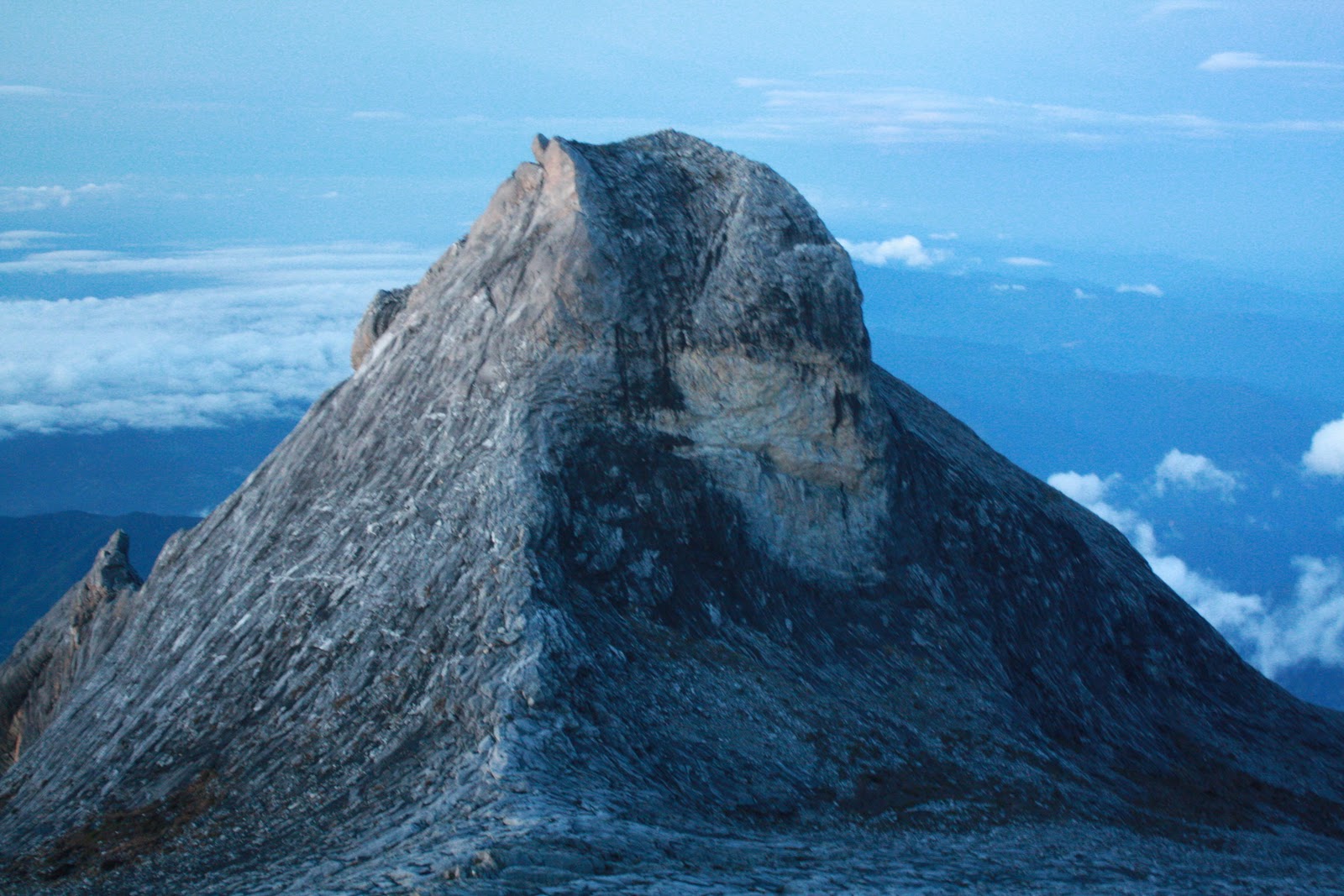
This is Mount Kinabalu, the highest peak in South East Asia and a stand-out landmark for miles around. We were going to climb it the next day, so snuck admiring (and slightly awed) glances through the shroud of mist that surrounds it.
But first, we bathed in the water and went on a canopy walkway in Poring Hot Springs.
 |
| Poring means a type of bamboo in Malaysian - this type, apparently. |
More pictures of Mt Kinabalu, this time from our verandah at the Wildlife Mountain Lodge where we stayed the night before our climb and drank gin and tonic to keep the mosquitoes at bay.
The following pictures are all from our climb of Mt Kinabalu so if you're not interested in mountains, I advise you to skip to the end now. I was exhausted on the way up so only took pictures at the overnight stop and on the way back down!
 |
| Him Outdoors at Laban Rata - overnight stop, 3,272m above sea level |
 |
| At the top - you can hardly tell I've got a touch of altitude sickness and hypothermia... |
 |
| Absolutely stunning at sunrise |
 |
| Him Outdoors in front of a formation called The Donkey's Ears, because... |
 |
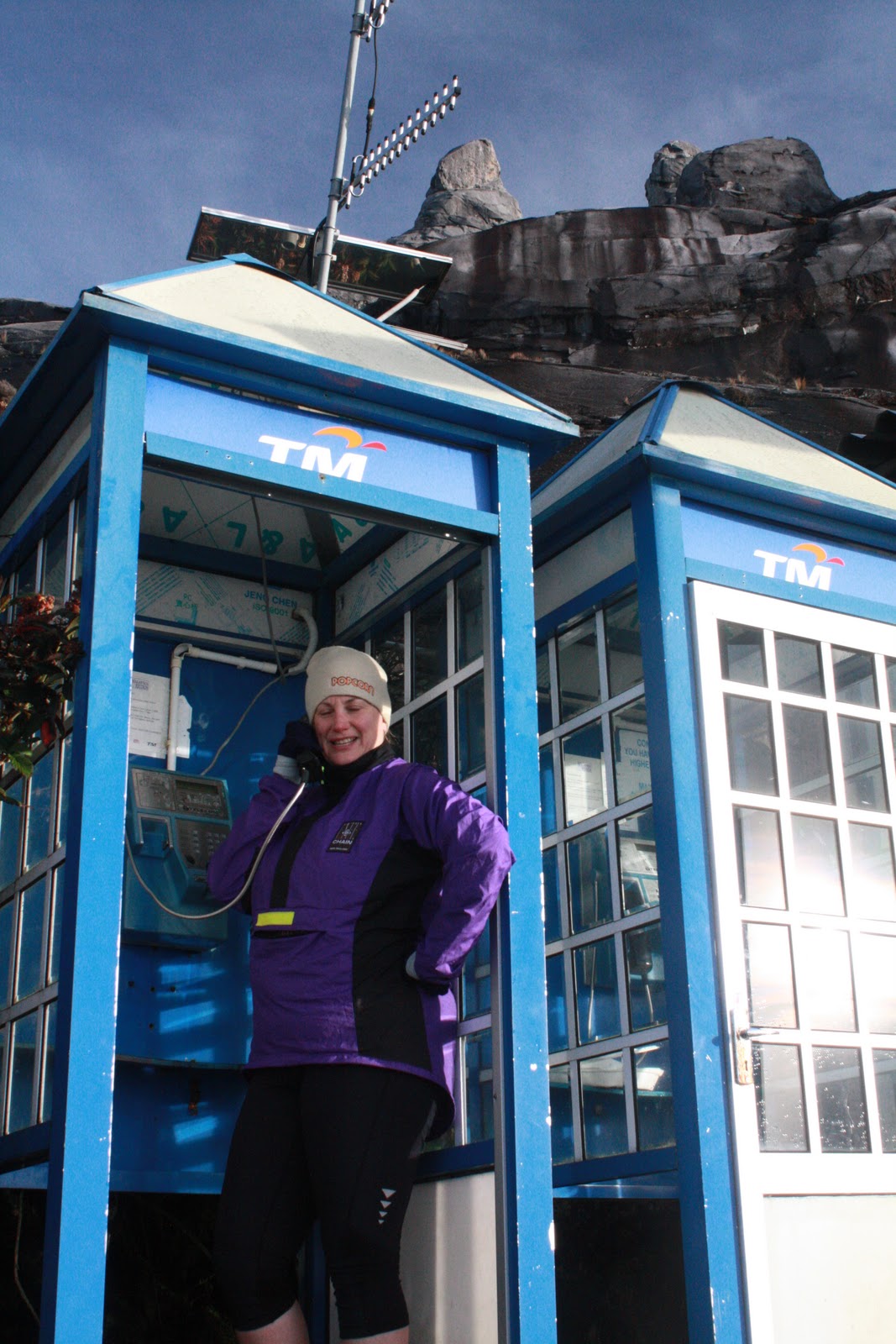
| The highest telephone booth in the southern hemisphere, or something |
 |
| Yep, looking much happier on the way down. |
Borneo has a great variety of pitcher plants. Of these, nine species are found only on Mt Kinabalu. Our guide had us scrambling up and down many banks to show us the rare varieties. He told me, 'I didn't think you are interested on the way up.' How perceptive.
The guides have to serve a four-year apprenticeship as porters before they become guides. As porters they carry up between 20 - 50kg on their backs almost every day of the week, using a contraption made of rope and bamboo. There is no helicopter access to Laban Rata so all the materials and supplies have to be carried in.
There is also a race, or climbathon (which we narrowly missed, phew!) up and down the mountain. This chap is carrying a table for the water station. It took me about eight hours to walk up and five hours to walk down. The athletes run the whole lot in about two-and-a-half hours. Nutters! This year Kiwi Anna Frost came second in the women's event with a time of 3:50:35. Wow!
The race advertising asks, 'Are you tough enough?' No, is the answer to that. I am not alone - this year of the 497 competitors who began the challenge, 139 completed it - that's 28% - not great odds. I'll stick to grovelathon, thank you. Him Outdoors, of course, is keen to do it next year...