Restrictions are easing; pubs are opening; beer is being poured. It would be rude not to.
 |
| Beers with chums at To All My Friends |
At the end of November I'm walking The Bloody Long Walk with friends. It's 35km and goes from the top of Red Hill, through the posh suburbs of Canberra where all the embassies are, skirts Parliament, and then round the lake. We have started doing some 'warm-up' walks so that we know the route and are aware of the distance.
For Part One we walked from Red Hill to Lennox Gardens. One of the things I like about Canberra is that all the embassies are designed to reflect the architectural features of the country. Here are North Korea and India.
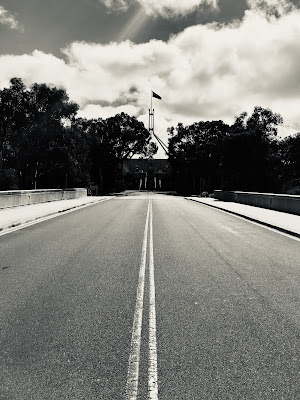
The route goes around Parliament, where people with guns patrol the grounds. I always feel anxious seeing people bearing guns, but they were all very pleasant.
There are formal gardens on the eastern side of Parliament House (inspired by English and French formal garden designs). The gardens are guarded by a pair of lions, traditionally installed at the entrances or imperial and government buildings in China. They are usually found in pairs, the male resting a paw on a ball, and the female restraining a playful cub on its back. These guardian lions were a gift from the People's Republic of China in 1988.
The traditional water feature in the centre creates gentle sound and movement and is surrounded by displays of annuals with approximately 3,500 plants, which are changed in spring and autumn.
We also walked past Old Parliament House, where the wisteria was still in bloom.
Across the choppy waters of the lake, the National Museum sits on Acton Peninsular. Design Diva told me that it was formerly the hospital for Canberra, which is not ideally situated as there was limited space for growth and only one way in and out. On 13 July 1997, the plans to demolish the old buildings went horribly wrong. Over 100,000 people attended the implosion from the other side of the lake; one of the largest crowds in the history of Canberra. Unfortunately, large pieces of debris reached across the lake injuring nine people and instantly killing Katie Bender, a twelve-year-old girl. The main building did not fully disintegrate and was manually demolished afterwards. There is now a memorial on the site to Katie Bender.

At Lennox Gardens we find the Canberra Nara Peace Park and the Beijing Garden. A distinctive feature of Canberra Nara Peace Park is its 'borrowed landscape', or the extension of the park's boundaries to encompass landmarks such as Lake Burley Griffin, Black Mountain, Mount Ainslie and Lotus Bay.
Toku was commissioned to celebrate the 1,300th anniversary of Japan's ancient capital, Nara. The sculpture has three main elements: a five-storied pagoda form which represents Canberra; a floating stone representing Nara; and the form of a small bird symbolising peace. The bird (on the left-hand corner of the second tier down) represents a Latham's snipe, a species which migrates annually between Japan and Canberra. The artist has created Toku to express the amicable relationship and mutual understanding shared by Canberra and Nara as sister cities.
 |
| Toku (2010) by Shinki Kato |
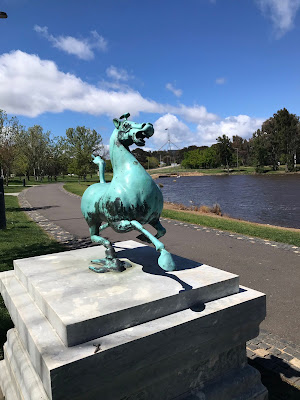
It seems the Chinese like to create statues of animals coming to harm. Bronze Galloping Horse Treading on a Flying Swallow is regarded as a national treasure; a famous representative sculpture from the Eastern Han Dynasty (25-220 AD). The original sculpture was unearthed in Wuwei County, Gansu Province. Apparently, 'this reproduction depicts the Heavenly Steed of Chinese legend, in dynamic flight with one hoof stepping on the back of a swallow, accentuating the speed and power of the horse'.
 |
| Bronze Galloping Horse Treading on a Flying Swallow |
 |
| At least these cranes look unharmed |
I liked the four celestial symbols, which are creatures in Chinese mythology that represent the four cardinal points and the four seasons. They are the Black Tortoise (north/ winter), the Azure Dragon (east/ spring), the Scarlet Bird (south/summer) and the White Tiger (west/ autumn). Representations of the Four Celestial symbols date from the Spring and Autumn and Warring States periods of China (475 - 221BC).
One particularly odd thing was the Stone of Appreciation from Tai Lake. The plaque informs us that limestone from Tai Lake has been prized as garden ornamentation since the Tang Dynsaty (618-907 AD). Also known as Chinese scholars' stones, rock specimens are admired for their convoluted forms and the balance of strength and delicacy.
The Stone of Appreciation displays the four recognised qualities of fineness (shou), openness (tou), perforations (lou) and wrinkling (zhou). I'm pretty sure I display some of those qualities too. Design Diva pointed out that the reciprocal colonisation process continues as the stone appears to be a breeding ground for local spiders.
 |
| The Stone of Appreciation |
There's also a small section of the gardens planted with colourful azaleas and rhododendrons, bordered by dainty little pathways.
 |
| More red and white azaleas |
We finished our walk by returning to the start point (where we had left a vehicle - the organisation of parking cars at each end was a bit befuddling that early in the morning) and having a hearty breakfast at the Redhill Café & Bar.
And we finished the weekend with bubbles and soup at the home of Dr Kay and Patience Itself, where we celebrated their beautiful spring blooms for Azaleiade.